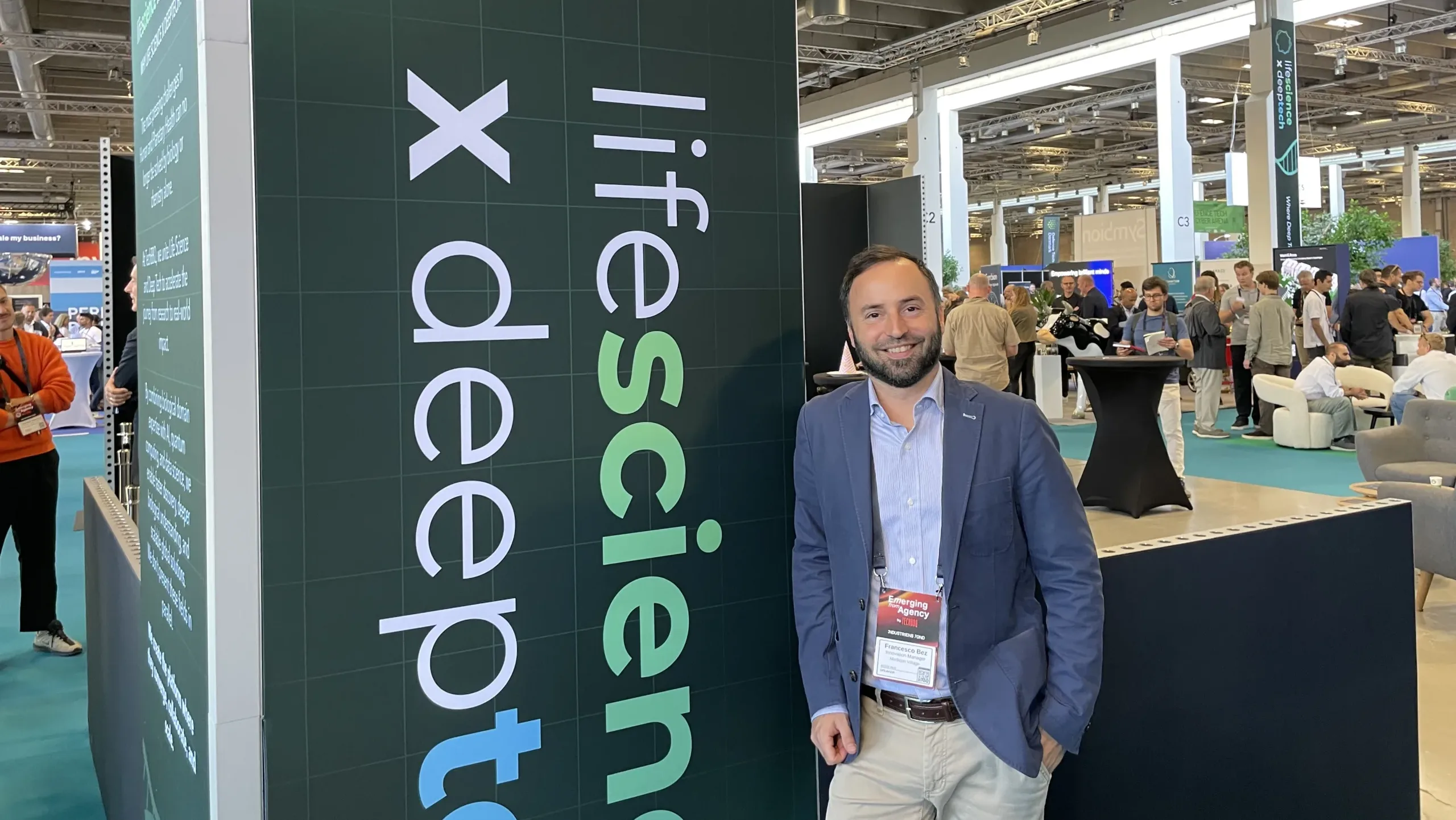
I förra veckan gick årets upplaga av TechBBQ av stapeln i Köpenhamn. I år deltog Medicon Village genom ett icke-kommersiellt partnerskap som ska stärka kopplingarna mellan life science- och techmiljöerna i Öresundsregionen.
Innovation Manager Francesco Bez medverkade i panelen ”Behind Every Founder: The Communities Powering Life Science”. Diskussionen kretsade kring vilken roll starka ekosystem och nätverk spelar när grundare ska ta tidiga idéer till livskraftiga bolag – och i förlängningen till verklig effekt. En bärande poäng var att den vetenskapliga idén bara är startpunkten. I de tidigaste faserna behöver grundare tillgång till rätt kompetens, människor, infrastruktur, investerare och nätverk, och ett starkt stödsystem kan avgöra hur väl man lyckas navigera de första utvecklingsstegen.
Efter panelen fick BioStock möjlighet att prata med Bez om just ekosystemets roll – och om den svåra balansgången mellan att uppmuntra bolag att bli globala och att behålla värde i den egna regionen.
Francesco Bez om ekosystemets roll
You were just in a panel discussion. What would you especially like to highlight from it?
– For me, this is very much what an organisation like Medicon Village is about. It is not only about providing a physical environment for companies, but about creating connections between founders, researchers, healthcare, industry, investors and other ecosystem partners. The stronger those connections are, the better we can support companies from the earliest stages of development.
You also mentioned that it’s great for European and Nordic life science companies to receive US funding, while the flipside is that they might leave Europe and/or the Nordics. What do such moves mean for the ecosystem back home?
– US funding can be extremely positive for a European or Nordic life science company. It can provide access to substantial capital, expertise, networks and, importantly, the US market. So, the objective should certainly not be to prevent companies from going to the US or attracting US investors.
– The challenge comes when attracting the US capital also means that the company, its talent, intellectual property or future activities gradually move out of Europe. If that happens systematically, we risk creating a situation where the Lund/Skåne/Öresund region, and Sweden and Denmark as nations, are very good at generating scientific discoveries and early-stage companies, but other markets capture a large part of the value created from them.
What could the underlying concern be?
– For the ecosystem, that can mean losing companies that could otherwise have become important employers, partners and investors in the region. It can also weaken the entrepreneurial cycle. Successful companies and founders often reinvest their experience, capital and networks into the next generation of companies. If too many of them leave permanently, we lose part of that feedback loop.
Is there an important distinction between a company becoming international and a company disappearing from its home ecosystem?
– Yes! We should absolutely encourage Nordic companies to become global, but ideally they should be able to remain connected to – and create value in – the ecosystem where they originated. Perhaps going to the US, using the investments to grow, but maintaining a foothold, or the R&D, or part of the company in Sweden and the Nordics.
That leads us to the million-dollar question: how do science parks such as Medicon Village and the ecosystem in general solve this balancing act?
– There is no single solution, because this is ultimately about the availability of capital, talent, infrastructure, markets and the conditions for companies to scale. But science parks and ecosystem organisations can play an important role in building the conditions around companies so that staying connected to the region remains attractive.
What measures can be taken to ensure that outcome?
– First, we need to support companies much earlier. If founders have access to strong networks, relevant expertise, infrastructure, knowledge-sharing networks and investors from the beginning, they are better positioned to grow from the Nordic ecosystem rather than having to look elsewhere for every critical resource.
– Also, science parks can remain a platform for collaboration, talent, research, infrastructure and partnerships, giving companies a reason to maintain a presence here even as they expand internationally.
– I mean, the ambition should not be to keep Nordic companies small or prevent them from going global. Quite the opposite. We should build an ecosystem strong enough that companies can grow globally while continuing to have a meaningful foothold in the Nordics.